Thank you for Subscribing to Agri Business Review Weekly Brief
A featured contribution from Leadership Perspectives, a curated forum for agribusiness leaders across the agricultural value chain, nominated by our subscribers and vetted by the Agri Business Review Editorial Board.

VA
AgTech Revolution for Sustainability
Lowland Hum
Adrive through the California countryside after a long and hectic week is still the best soothing experience for many. The lush green fields in a sunny morning and the close encounter with the mother nature just drive away all the blemishes of mind. You are driven by an unknown force to stop the car and fill your lungs with unpolluted and fresh air. What happens next is quite spontaneous - you lose yourself. And a bunch of questions flock around your mind: how are those fields filled with crops? Or, how does a farmer maintain it?
The answer to these questions could be simpler even a decade back—tireless endeavor of a farmer. But, the rapid boom of agricultural technology in the past few years has made technology a key driver of the U.S. agriculture industry. Today, AgTech, from vertical farming to data science to farm drones, rightly complements a farmer's efforts and makes them more productive and profitable.
The Journey toward Agricultural Excellence
While "AgTech" has appeared as a buzzword, the agriculture industry has never been hesitant to adapt to changes and innovation, from wooden animal-driven ploughs to tractors. However, in today's context the concept of "AgTech" entails much more. To elucidate, data and information have become increasingly crucial for the agriculture sector to improve productivity and sustainability. To this end, Information and Communication Technology (ICT) plays a vital role by paving the way for improving the effectiveness and efficiency of data collection, storage, analysis. It enables agricultural practitioners to seamlessly acquire critical information and make better decisions to improve everyday farming. A great example of this can be the remotely sensed data on soil conditions that supports a farmer's crop management initiatives. In this regard, we cannot negate the importance of the Global Positioning System (GPS) that equips the agriculture sector with the capability to seamlessly navigate specific locations in the field, year after year and monitor crop conditions. It also provides accurate information regarding the pest, insect, and weed infestations in a particular field. This takes away the pain of physically monitoring the fields everyday and enables farmers to save time.
A drive through the country to soothe the mind An emerald field is a sight for sore eyes Picture the pose of the figure
underneath Shoulders and hips draped in green.
All these technologies and the associated benefits contribute to the greater concept of smart farming or making farms more interconnected for the improvement of product quality and quantity. Also, it promises a feasible way forward to solve another crucial problem that has burgeoned into a headache for the agriculture industry-management of demand and supply. It provides farm practitioners with all the crucial information to better manage the supply of land and its condition for producing the right crop that is in demand.
This concept of data-driven farming is not just only to make the lives of farmers more comfortable, but it sets the premise to solve a greater global problem. According to the United Nations, the global population is going to touch a north of 9.8 billion by 2050. Feeding this huge number of people is going to be a task easier said than done—unless we prepare from today itself.
At the same time, climate change has made it really difficult to increase the crop yields with conventional means— making indoor farming a viable alternative. This microcosm of our food system requires cutting-edge lighting and water supply solutions to ensure considerable amount of production. Indeed, digital technology has a critical role to play for making farming more viable and fruitful.
From Finance to Agriculture - the Potential of Groundbreaking Blockchain Technology
Another key innovation that is going into the agriculture space is the growing utilization of the blockchain technology. It is considered as one of the most disruptive technology for the world of finance. However, today the boundary of this distributed, shared ledger has grown drastically—so much so that it is affecting the status quo of multiple sectors, including the healthcare, retail, and telecommunication. Fortunately, the agriculture sector is not lagging behind in this race. By enabling transparent peer-to-peer transactions, blockchain diminishing the need for an intermediary body. As a result, the whole concept of "how is trust is granted" is changing. And this plays a vital role in restoring the trust between the producers and consumers and cutting down the transaction costs in the agri-food market.
Also, in the complicated agriculture space this specific technology has a lot to contribute. For example, the concept of index-based insurances—triggering payout by a measurable index—is gaining traction in this specific area instead of the traditional indemnity-based insurances. Blockchain has the immense potential to optimize index-based insurance in two primary ways. First, it can ensure payments are made on a timely basis and in an automated way. Secondly, using blockchain, critical data sources, including plant growth information or farm machinery data, can be easily combined through a smart oracle for basis risk reduction and making the index determination and payout process more effective in nature. Needless to say, the decentralized storage architecture completely ensures data security and seamless data flow among all the key stakeholders.
Marching toward the Next Agri Revolution
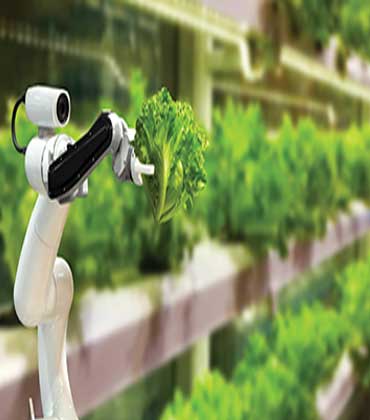
There is no way to deny that all these technologies are opening the door for a new era of agriculture. And fortunately, this is not limited to IoT, Big Data, or Blockchain. Several nimble startups are coming out as well to address the ground realities of the agriculture sector. They are introducing groundbreaking tech innovations to provide hybrid field crop seeds, microbebased plant protection products, climate-controlled facility solution, or process discarded agricultural plants for the production of biologicals to preharvest fruits and vegetables and protect them from biotic and abiotic stresses. Harvest robots and autonomous tractors are also earning popularity in today's agriculture world. More importantly, continuous research works are taking place to make these robots more efficient and effective in nature.
With all these innovations in the horizon, it won't be a superficial statement that in the coming years, we will witness the industry evolving more and becoming more tech dependant. Needless to say, these innovations are not reducing the importance of farmers but making their everyday job easier and the profitability pie sweeter. This is holds great value in today's America where, according to many reports, mediumsized farms are almost facing extinction.
Next time, during a relaxing drive to the countryside, one might not remember the evolution of the agriculture sector. But the green fields will still be enthralling and soothing—because that's the promise of AgTech.
The articles from these contributors are based on their personal expertise and viewpoints, and do not necessarily reflect the opinions of their employers or affiliated organizations.
